Soul’s Zhang Lu Team Drives Offline Social Innovation, Partnering with DASH LAND to Explore New Forms of Emotional Connection
Soul’s Zhang Lu Team Creates “Emotion Bars”: Extending Social Interaction from Online to Offline Companionship
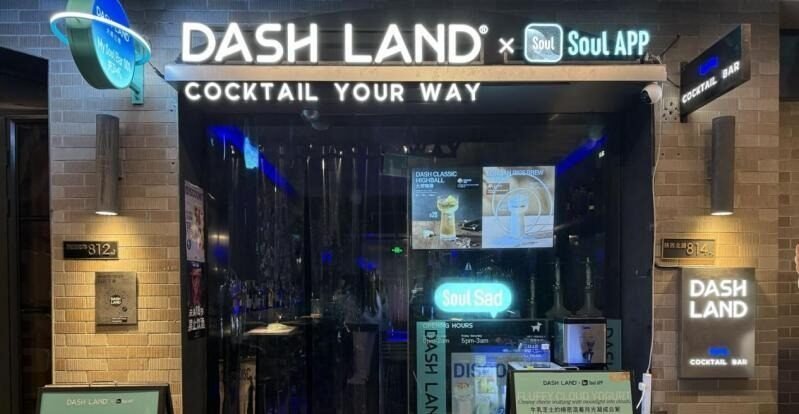
“My Soul Bar,” a co-branded bar concept jointly created by Soul App’s Zhang Lu team and renowned bar brand DASH LAND, has officially launched. As a key step in Soul App‘s offline expansion, the project plans to open at least 30 offline social spaces nationwide within the year. The first seven themed bars are already operational across Shanghai, Nanjing, Wuhan, and Kunming.
Unlike traditional bars that emphasize consumption, My Soul Bar focuses on integrating emotional expression with social experience. Through reimagined spatial design and social mechanisms, Soul brings its established online interaction model into real-world settings, bridging the online and offline experience. In this framework, themed bars serve not merely as gathering spots, but as concrete vessels for emotions and relationships.
From a product standpoint, Soul has consistently championed a “label-free” approach to socializing. On the platform, users interact through virtual avatars, reducing interference from appearance and identity to foster more authentic expression. This philosophy carries through to the bar setting. The “Masked Bar” concept uses famous-painting masks as an interactive medium, downplaying first impressions and redirecting conversation toward substance. This design is not merely formal innovation — it represents a fundamental reexamination of social dynamics.
Related research corroborates this trend. The Just So Soul Research Institute’s “Gen Z Drinking Lifestyle Report” found that 27.06% of young people consider taste to be the most important aspect of a drink, rather than stylistic labels. This shift reflects a growing embrace of a “label-free” mindset among young people, aligning with Soul’s longstanding product philosophy. From de-emphasizing external labels online to minimizing consumption symbols offline, Soul is working to build a purer interactive environment.
In terms of spatial design, My Soul Bar translates abstract interests and emotions into tangible expressions. For instance, the “Cry Bar” on Shanghai’s Shankang Li uses onions to create an “emotional outlet,” offering users a space where their feelings can be understood and accepted. This design addresses the difficulty many young people face in releasing emotions in everyday life, making “expression” itself a sanctioned act. Through spatial storytelling, emotions that once existed only as online tags are transformed into palpable experiences.
Soul’s offline strategy extends beyond expression to encompass the reconstruction of social relationships. Within the My Soul Bar system, different spaces are divided into an “Emotion Series” and a “Social Series,” serving the functions of personal emotional release and relationship-building respectively. The “Go Wild Bar” features zones for uninhibited expression, while certain spaces use rules to restrict specific information sharing, preserving only emotional exchange. These mechanisms lower communication costs, reduce evaluative pressure, and make socializing lighter and safer. Compared to traditional drinking culture driven by consumption and interpersonal obligation, these venues emphasize boundaries and individual experience. Users can choose solitude or forge new connections without bearing additional social burden.
The launch of the Soul × DASH LAND co-branded bars gives Soul’s online social philosophy a concrete, real-world form. Through seven established spaces, the platform’s interactive relationships are translated into real-life conversational settings, making social connection something experienced beyond the screen — a tangible part of everyday life. From online interaction to real-world companionship, this series of initiatives driven by Zhang Lu’s team represents not just a scenic extension, but a systematic exploration of contemporary social interaction.